Tracing the coordinates of absence

The afternoon was heavy with the sun and the sound of footsteps multiplying in the indifference of the street. I had been here for over two hours now, desperately looking for a shrine that I had visited once a few years ago. I pinched my mobile screen trying to zoom in and out on Google Maps; I was there, but where was the shrine? I knew that it had been bulldozed some months ago, but where was the debris, the broken green walls, the last rose that must have smelled the shrine intact? I decided to ask the passersby, and some told me to stop looking for it because it is no longer there, while others were surprised why I was labouring over something that does not even exist. Another hour and I finally saw that the rugged sequence of red sandstone slabs on the pavement was interrupted with the smoothness of granite. The municipal authorities had not only demolished the shrine, they had also cleansed the site of its debris, depriving us of even the last remaining traces of this decades-old structure, pulling out both the shrine and its absence. A few kilometres away, looking for another shrine, I found that saplings had been planted over the site of the bulldozed structure. Searching for yet another shrine, I saw the same smooth granite. Dargah Jinnati Baba, Dargah Bhure Mian, Dargah Hazrat Baba Khwaja Qutub Shah Chishti, Dargah Sharif Sunehri Baba, and more than a dozen other Muslim shrines in Delhi uprooted from their time—all crime scenes sanitised.
Authorities cite urban development, hampered traffic movement, and expansion of roads as reasons, keeping a litany of legal justifications handy. Law and beauty as instruments of violence against structures that are sometimes older than the nation-state that demands their annihilation.
To write about absence is to write an impossibility, to hold between our fingers a phantom spacetime that continues to leak from all gaps in speech. After structural exclusion and routinised segregation in the built environment, whatever negligible claim to space Muslims had in India is now being denominated by absence. A bulldozed space, a bulldozable space. More than 200 million Muslims are counted as citizens of India, but where is their place in the expansive territorial aggregate produced as the nation?
I rub my eyes as I search, but all I retrieve is dust. I move from Nuh to Haldwani, from Lakhimpur to Hardoi, from Mandla to Bhilwara—rubbing my eyes—and find only a negative cartography of all that once was and no longer is. More than a hundred thousand demolished homes, mosques, small shops, and shrines are the coordinates of a map which is the total inversion of the perennial national present. Here everything discarded, displaced, and dishomed is luminous and here is the long blue shadow shrouding our waking hours. Every complaint shared over evening meals, every laughter passed around from room to room, every secret, every yearning now locked into rubbled chaos, rendered colour-reversed.
Each moment when bulldozers moved through these terrified streets has been accumulating into an infinite cloud of vapour that thickens into its own nothingness. This is how absence announces its arrival—it is and it is not. While loss is a parenthesis in time, absence is all time turning mist. There exists a time after loss, the time to recover or reclaim, but absence imposes its own structure that folds all temporal thresholds.
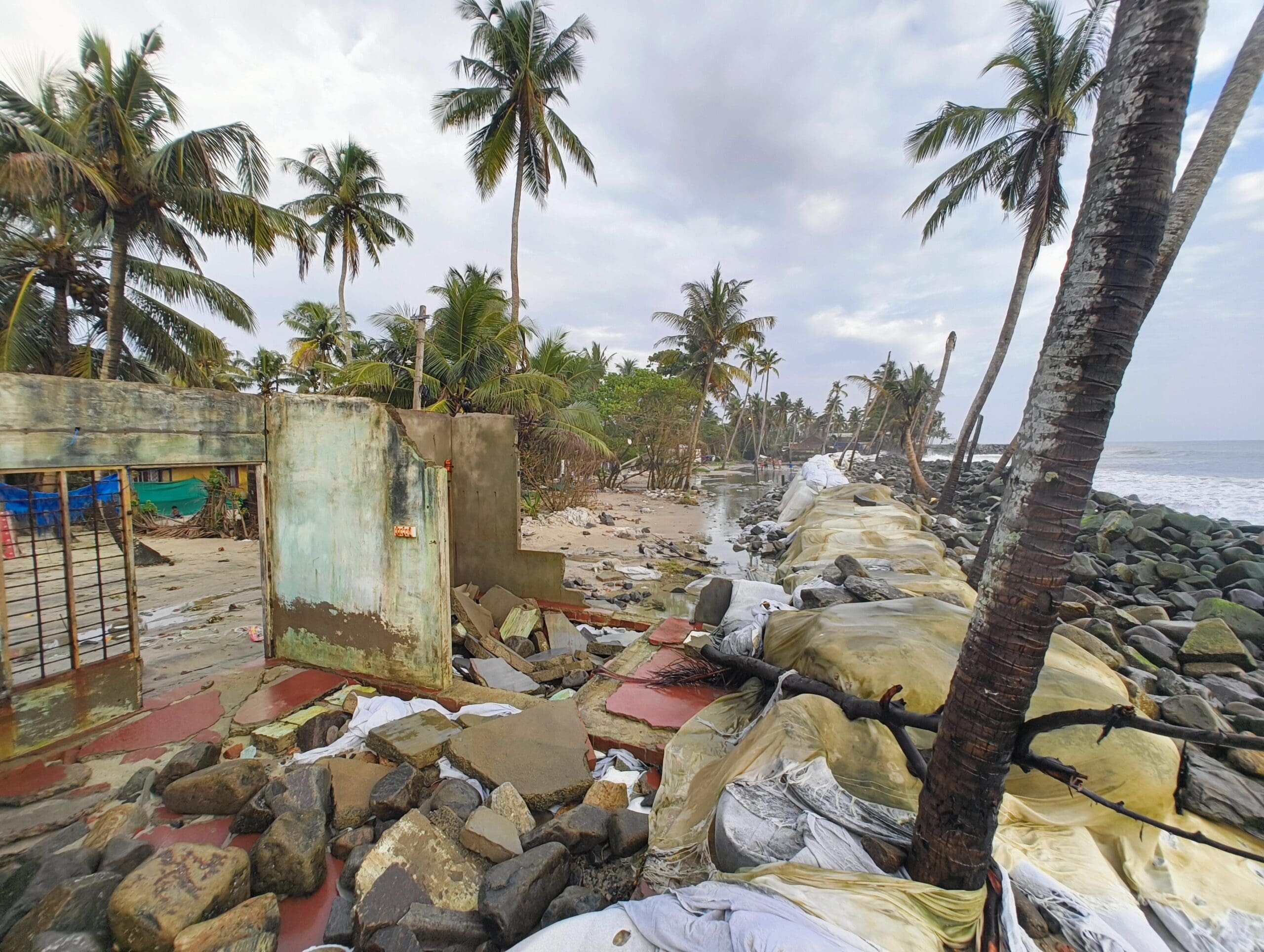
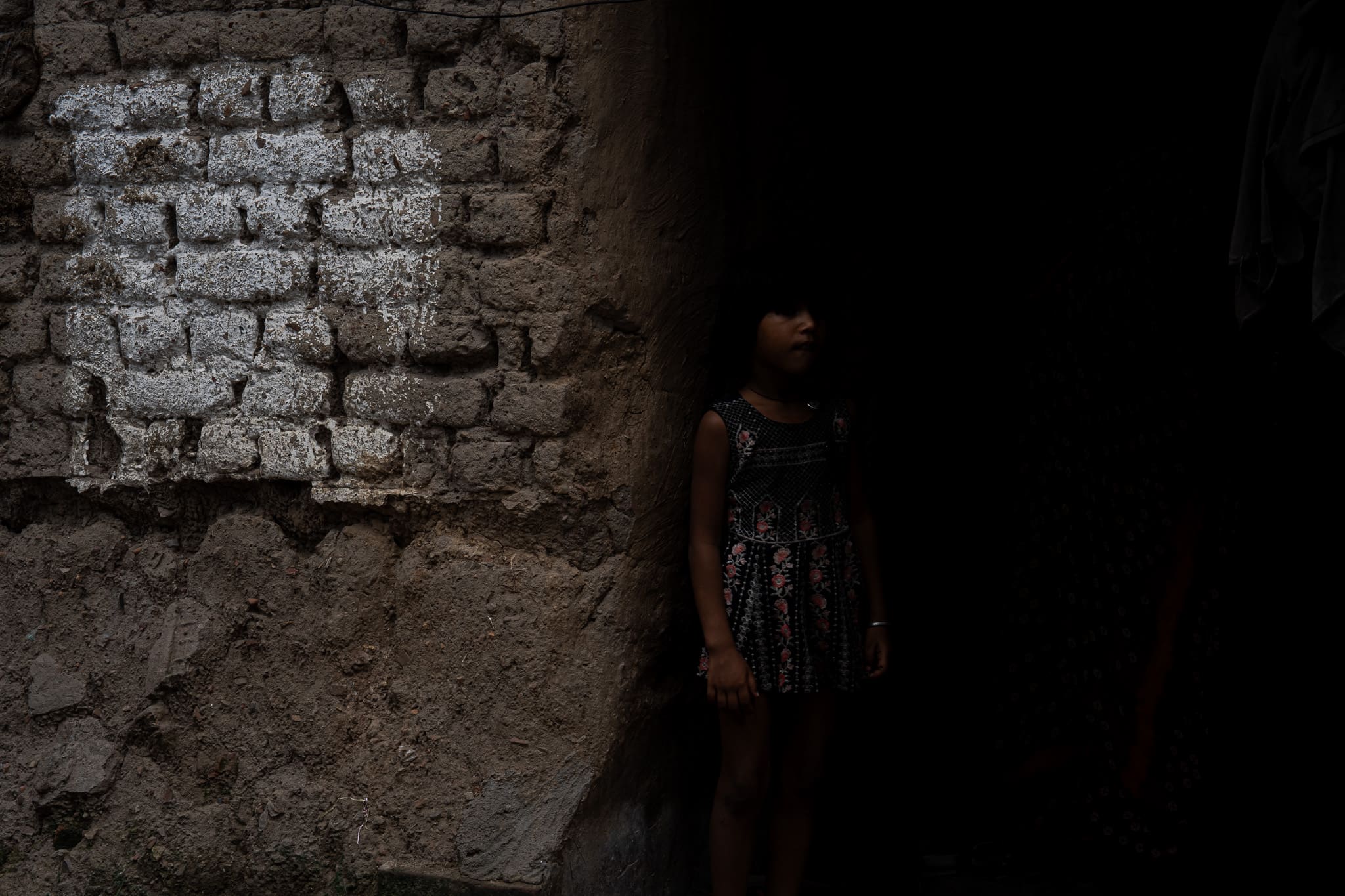
An entire population that is produced as the foundational mistake of the nation resides in this negative cartography with their half-lives. In Nayi Basti, Mathura, more than a hundred Muslim families are forced to live amidst the rubble of their broken homes. They refuse to move anywhere else, not just because they do not want to leave the place where their mothers and grandmothers took root, but also because they have nowhere else to go. Outside this splintered negative, they are a spatial blemish that must be cleansed and done away with. Their homes were labelled an “illegal encroachment” and demolished for the expansion of a railway line. One home is survived by a long green wall with five honeycomb shelves, whose chipped corners betray the pink that was hurriedly painted over. In another corner, two neighbours who would never speak to each other now find their rooms collapsed together, indistinguishable in their exhaustion. An old woman sits with the debris of seventy years, all her utensils lined neatly against the graveyard fence and her gaze fixed on her grandchildren’s sleep.
Tarpaulin sheets and thick curtains are makeshift walls for makeshift homes. There are no windows and all doors are hinged to wait. An unceasing stream of rubble interrupted only with a neem tree that offered its shade to the entire neighbourhood struck by the heat wave. It is not just homes that went missing after the bulldozers left, people too went missing from their own lives. Two brothers, who were skilled meenakari jewellery artisans, abandoned their craft to find work as manual labourers and run a small shop elsewhere. Against the degrading sanitary conditions, children grew up overnight and assumed household responsibilities—for many it began with lesser food and no school, while others quietly joined their parents to earn a daily wage. Half-lives persisting not to become half-deaths.
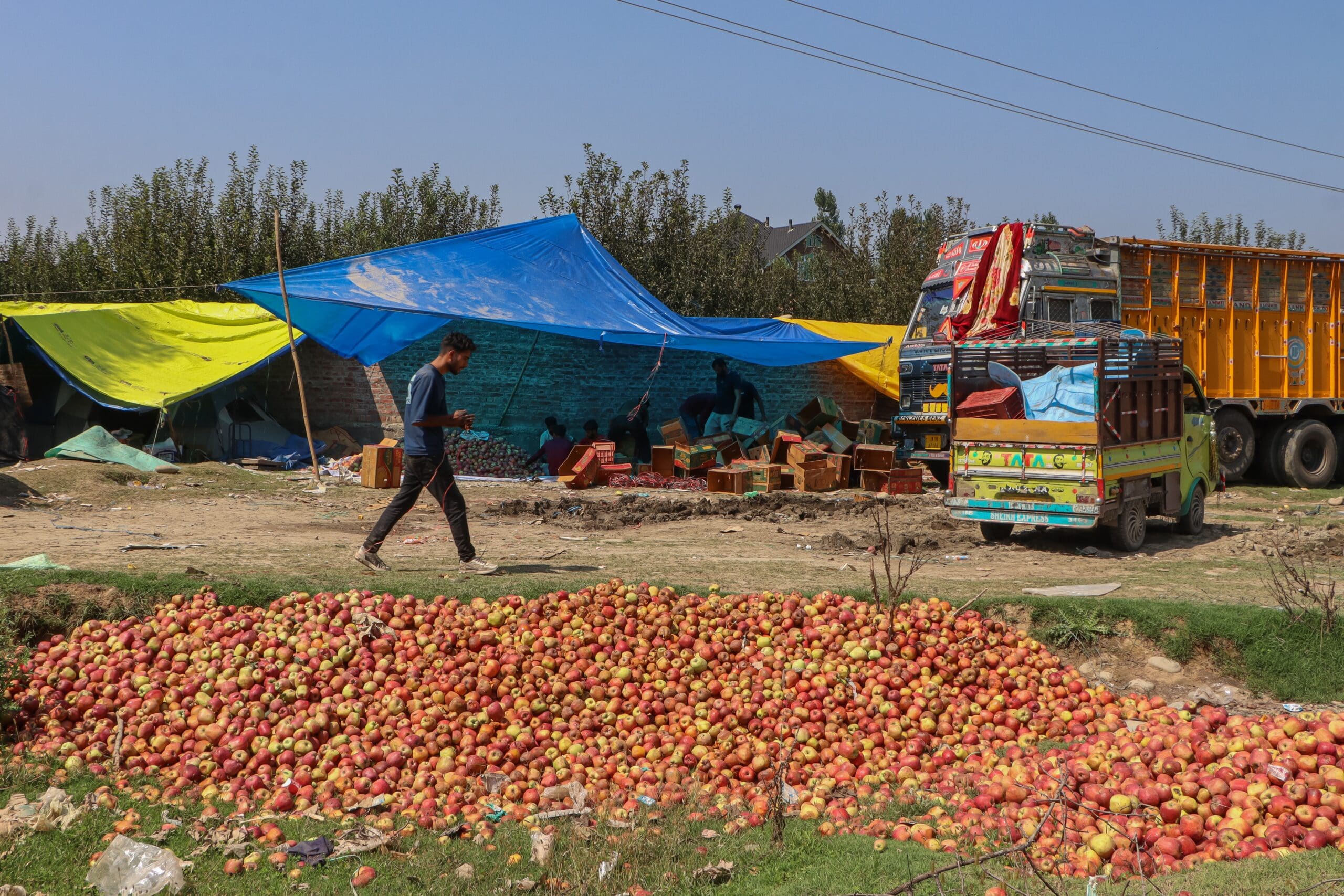
In Akbar Nagar, Lucknow, I decided to count each sapling that had been planted to grow the mythical forests, Saumitra Van and Shakti Van. I soon grew out of breath; it was futile to maintain a count of tens of thousands on fingertips. I was stubborn enough to continue counting because each sapling corresponded to each node of rubble of each home that once stood on this land. Thousands of Muslims from the neighbourhood were forced to watch their homes being demolished for the development of the Kukrail riverfront. Their residential area was termed a green belt, and their homes were declared “unauthorised constructions.” The people were removed and replaced with trees.
I soon found myself in the morass of newspaper headlines:
“Freed of encroachments, time for a river's revival”
“Sun sets on Akbar Nagar, new dawn awaits Kukrail”
“Akbar Nagar flattened, paves way for eco-tourism hub”
“Akbar Nagar buried in the pages of history”
“Yogi's bulldozer action continued peacefully in Akbar Nagar”
I was panting and continued to walk till I was surrounded once again by rubble, homes that were still breathing, that had not yet been concealed under a forest. A family of three had come to inspect the remains of their home, its ashen entrails. The mother told me that they were not allowed to take even the last residue of their life, that they could not retrieve their children’s books, their home appliances, their identity documents. They were denied even the debris of their own home. We saw rows of trucks stealing their rubble, a private contractor who had won the tender to extract profit off broken bricks and bent iron slabs. A dog wearing the night kept on circling us, so dark that our speech broke into stutters. There was no way to speak as palms clasped all sweat and throats ran dry. This was a violence designed to be unspeakable. We remained in its night.
Weeks later, it was in Tughlakabad that my feet were stung by absence. Almost a quarter million people, mostly Bangla-speaking migrant workers, were evicted from this Muslim-dominated neighbourhood. They were gone, so too were their tin-roofed tiny homes. Walking in that absence, I could still feel their homes; the loud morning fights, the drooping clothesline, the yellow entrance were still there, now as dust, now in another form, now elusive.
In this topography of ruination, we are always smeared with the dust of broken homes. Under our feet, all over our skin, inside our breaths. Interrupted lives, but a haunting unceasing afterlife. In this negative cartography, absence is our address and we memorise each coordinate with grains of dust. We are a communion of exhausted people, tired from this world of the living, we inhabit the ghost of all neighbourhoods eclipsed from your sight. For us, the air is always thick and the earth is always heavy because our time is saturated with absence. Porous, these broken homes pass through us as we pass through them. Each loss, distinct and singular, is our fractal sum.
We are rubbing our eyes, we want
to sleep, we are always
waking up; there is so much dust.
Because this absencing is simultaneous, this absencing is relentless, we have not been allowed to mourn. Martyred mosques, windows stabbed to the limit of shards, and walls pounded till they could no longer cradle the twilight are waiting to be mourned. How can we practice language holding the hardened rind of the alphabet? We only have rubble to turn to, rubble as speech and evidence of all that is being erased. We are a communion of exhausted people, following the faint trail of what was, and what remains, in our memory. Like ants, we persist and march through the cracks, tracing the scent of absence.
I salvaged a clock from the debris in Nuh, Mewat, a year after a thousand homes, shops, and shanties were demolished in the district. Its needles had been wrenched out and some numbers had gone missing. Time was decaying.
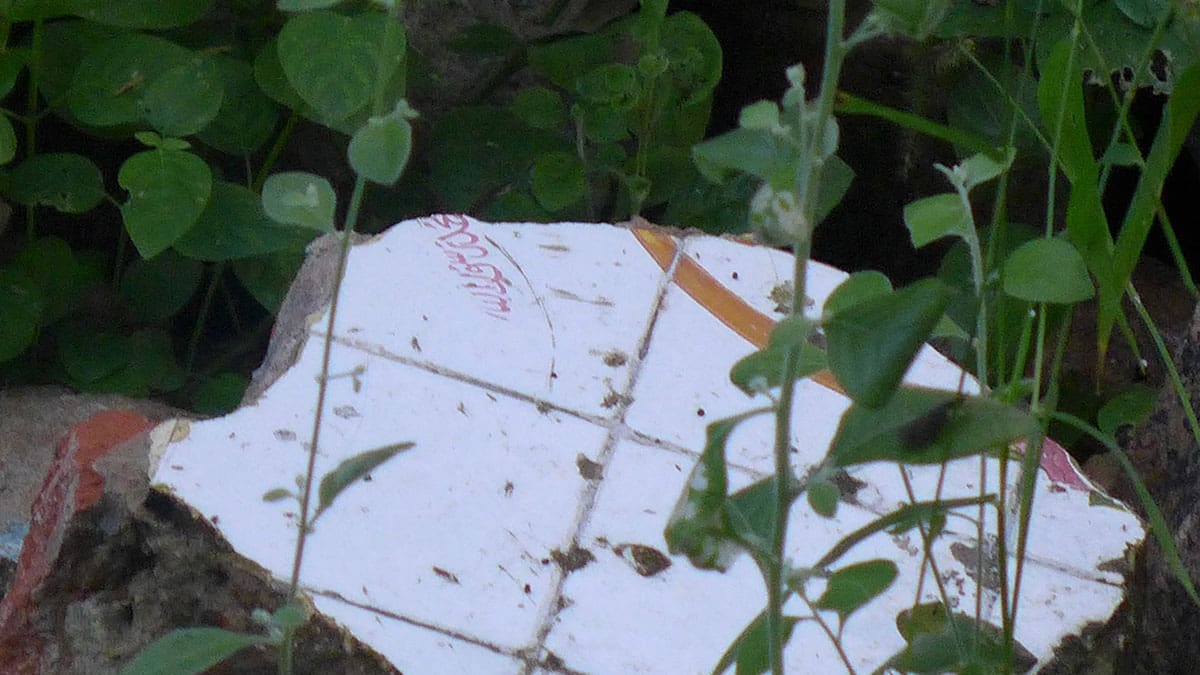
In fact, in the afternoon that was heavy with the sun and the sound of footsteps multiplying in the indifference of the street, I had found time broken. When those shrines were bulldozed, a temporal arrangement had been disrupted: a saint who was buried next to his disciple or mazaars that formed their own congregation were now forcibly scattered. I found the remainder of one missing shrine inside a local graveyard, displaced from its ancient sacred context, sitting in silence amidst the dead.
Rubble is producing us as a people expelled from space and exiled from time. How are we to derive meaning from this ontological fracture? The community is being dislodged from the intimacy of their homes as well as the dignity of belonging to a shared history. Dwelling in the chronotope of absence, our collective memory is a withered negative and its withering shadows, these mnemonic fragments of lack that are to become the inheritance of our future. One generation bound to another with what has long eroded. In the aching bewilderment of absence we become anachronistic beings — this absence imposes on us the obligation to remember as well as the need to forget. Are we to be in the time of absence, or in the time of absence of absence?
I measure the age of the republic with every number that corresponds to the lynching, massacres, dispossession, and ruination of my people. The republic is very old, yet there is no memorial for any of its crimes. Saplings and smooth granite, green curtains and fresh paint, the same drains and the same gates; as if nothing happened. The streets move on and entwine themselves around normalcy. What can be the memorial for our dead, the monument to their memory, to our memory? Do the ones perpetually suspended in absence even need a memorial to remember, to forget?
In Sambhal, Uttar Pradesh, five young men were killed by the police forces as they were protesting against a court-sanctioned survey of the 16th-century Shahi Jama Masjid. These martyrs sacrificed their lives and became an absence to protect their mosque from turning into another absence.
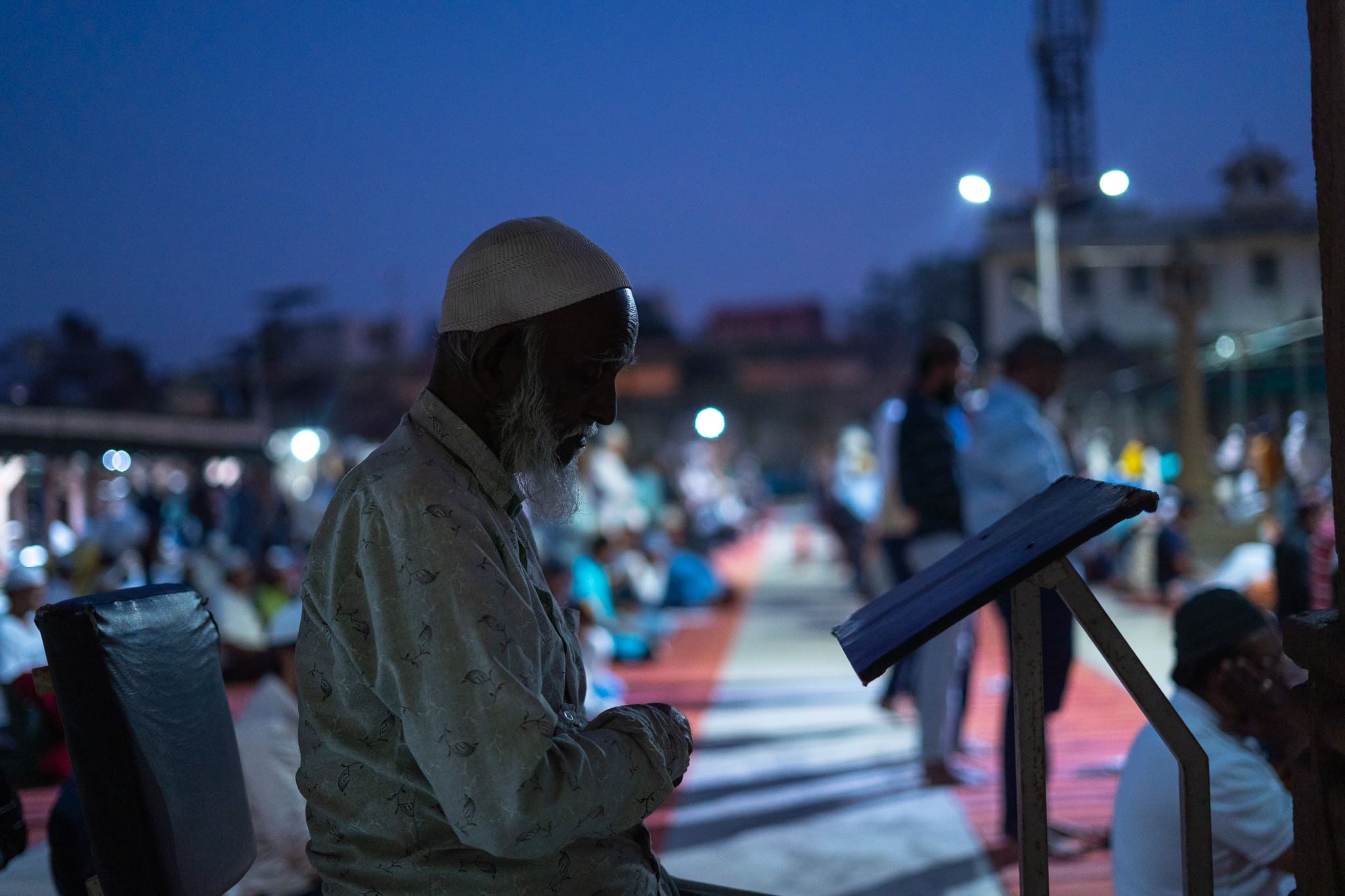
Moon-bitten hours continued to faint in my eyes as I sat all evening waiting for him. I could see how meticulously he had rearranged the stones of the shrine, but he was not here, nor was the shrine. The grave of Baba Haji Rouzbeh inside Mehrauli’s dense forest was more than 900 years old when it was demolished by the Delhi Development Authority after being labelled an “encroachment.” But it did not affect the khadim of the shrine, who continues to maintain its sanctity. He still lights earthen lamps, he still offers roses and prayers, he still seeks his saint’s blessings with an ornate chadar. For him, the shrine is, and will be. He holds the corpse of the structure, collects all its parts and honours them into a caress, restoring the shrine to its wholeness. This is how he practices beauty with his ethic of absence. It is the absence of this shrine that remains enveloped in the soft embrace of incense and attar. A fragrance that lingers over each stone, each crushed brick, each grain of dust.
Refusing to be seen, he finds his own language, a secret lexicon that is obscure to the perpetrators. His language that grapples with its own failure, a language of darkness that allows him to see this impossible “whole.” With this veiling, he constellates an architecture of refusal against this rubble. He begins his mourning by transgressing all rules of speech, where, charged with spectral presence, absence asserts its kinship with brokenness.
As more Muslim neighbourhoods and histories continue being razed to the ground, it is perhaps tempting to surrender to the despair of thinking that nothing remains. But for khadim sahab, this absence became Nothing, and he proclaimed instead that Nothing remains.
This essay was first published in Chutney Magazine Issue 04 in April 2025