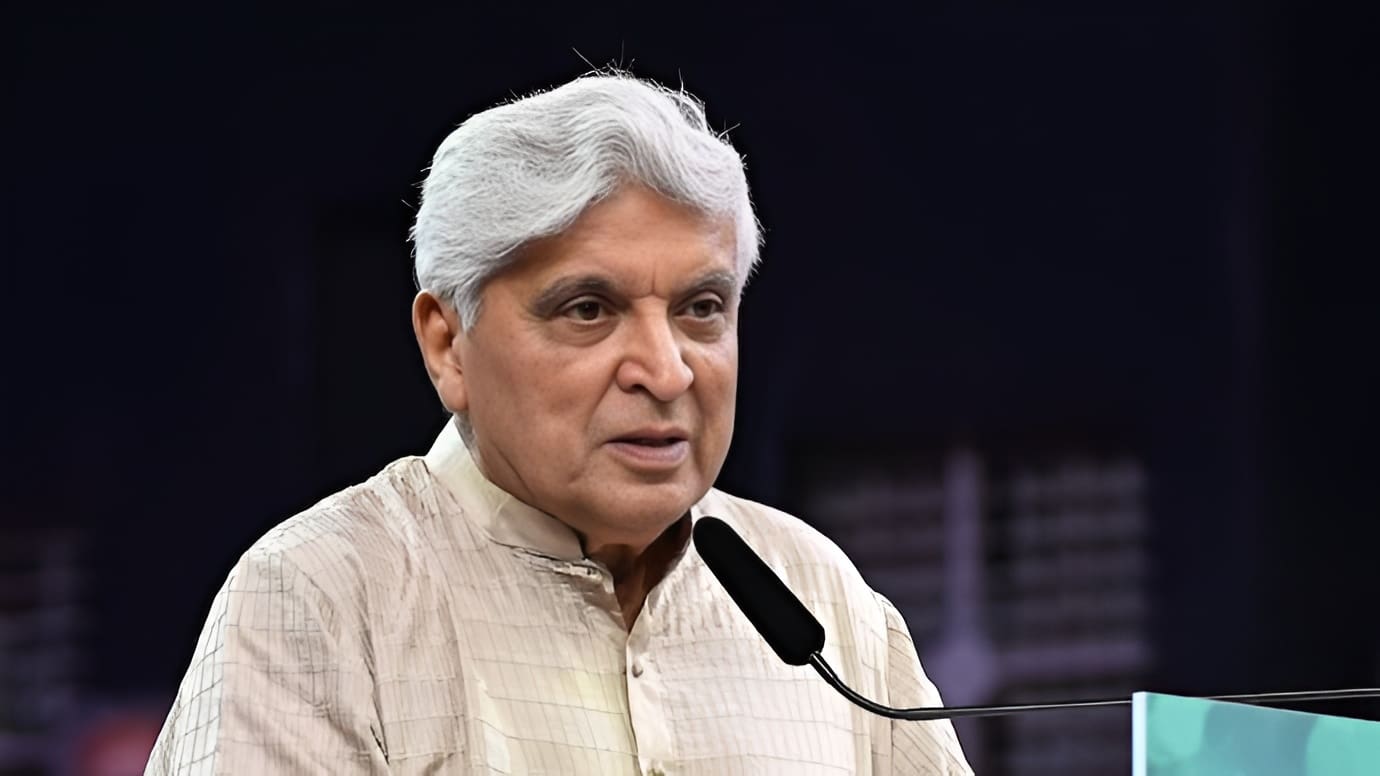
Selective atheism and political opportunism: The Javed Akhtar debate

The controversy surrounding Javed Akhtar’s removal from an Urdu festival in Kolkata is not merely about free speech—it exposes the contradictions of selective atheism and the political opportunism it enables. While Akhtar presents himself as a fearless critic of all religions, his embrace of Hindu nationalist symbols, slogans like Vande Mataram and Bharat Mata ki Jai, and cultural iconography reveals a comfort with the religious majority that contrasts sharply with his relentless criticism of Islam. At the same time, political actors and sections of the media have turned this incident into a convenient tool to attack Mamata Banerjee, obscuring the deeper crisis of democratic erosion and the privileging of majoritarian narratives.
The media-driven narrative rests entirely on unnamed sources, with no direct quotes from organisers or the accused groups lending it credibility. In fact, one of the two organisations blamed has issued a public press statement denying involvement, casting further doubt on the entire case.
Segments of the political Left and the liberal intelligentsia have seized upon this dust-up to attack Mamata Banerjee, portraying her as submissive to fundamentalists and falling into the BJP’s long-favoured narrative of appeasement. What began as a minor incident has been elevated into a moral indictment, obscuring the deeper contradictions at play.
Much commentary paints Akhtar as a bold defender of free speech, silenced by intolerant religious extremists. Yet this framing conceals the inconsistencies in his own politics.
Selective atheism in practice
Akhtar proclaims himself an atheist who opposes all religions, but in practice, his criticisms are disproportionately aimed at Islam, while he freely lauds Hindu cultural symbols. For instance, at a Deepotsav event organised in Mumbai by Raj Thackeray’s Maharashtra Navnirman Sena, Akhtar urged attendees to chant “Jai Siya Ram”, describing it as the finest example of love and unity. He emphasised that Lord Ram is part of India’s culture and civilisation, and that Rama and Sita are not only Hindu deities but also integral to the country’s cultural heritage.
At the same event, he declared that although he is an atheist, he respects Maryada Purushottam Ram a great deal, adding that the Ramayana is cultural heritage. He went further to claim that Hindus are generous and large-hearted and that democracy exists in India because of Hindu culture and tradition.
Akhtar’s visible comfort in embracing Hindu symbols and slogans stands in stark contrast to his relentless criticism of Islam, a selective atheism that risks reinforcing societal biases.
Praising Vande Mataram and Bharat Mata ki Jai
Akhtar has also defended the national song Vande Mataram. In a 2009 interview, he dismissed controversy over its association with Islamic objections as a non-issue. He pointed out that he has used the phrase in multiple films, including Saza-e-Kala Pani and Phir Bhi Dil Hai Hindustani, and even in a production staged at a military academy in Dehradun.
Yet the unease around Vande Mataram is not incidental. Composed by Bankim Chandra Chattopadhyay in the 19th century, the song is embedded in the imagery of goddess worship, with the motherland depicted as Durga. For many Hindus, this is a fusion of nationalism and spirituality; for Muslims, it raises a theological conflict, since the song equates the nation with a goddess figure. To demand its recital as a test of patriotism is to compel non-Hindus into an act that can contradict their own faith.
Similarly, the slogan Bharat Mata ki Jai—though now positioned as a patriotic cry—draws from the same cultural wellspring. Bharat Mata, or “Mother India,” is not merely a poetic metaphor but a visualised Hindu deity, complete with crown, trident, and lion. The invocation carries clear religious connotations that extend beyond civic nationalism. For those who resist chanting it, the issue is not a lack of loyalty to the country but the implicit demand to bow before a religious icon cloaked in nationalist garb.
By embracing and normalising these symbols, Akhtar effectively sidesteps the religious baggage they carry, placing himself comfortably within the cultural majority. His repeated criticism of Islamic practices, juxtaposed with his defence of slogans rooted in Hindu devotional imagery, underscores the asymmetry in his so-called atheism. Far from dismantling the religious hold on politics, this selective embrace strengthens it.
Political and social ramifications
This selective atheism has consequences. In a climate where Muslims already face discrimination, Akhtar’s criticism of Islam carries weight. His remark on housing apartheid, where he implied that the community itself was responsible for residential segregation, was not just factually fragile but also dangerously shifted blame from systemic bias to the victims themselves.
At the same time, he continues to appear frequently on elite cultural platforms, often corporate-backed, including those linked to the Ambani family. This sits uneasily with his professed leftist ideals and reveals a glaring opportunism.
This behaviour recalls the trajectory of Richard Dawkins in the West. Once admired as a fearless critic of religion, Dawkins has increasingly narrowed his focus on Islam, often in ways that dovetail with far-right talking points and anti-immigrant rhetoric. His atheism, once universalist in tone, has been hollowed into a selective campaign that punches down rather than up, inadvertently bolstering prejudices instead of dismantling them. Akhtar’s cultural positioning operates in a similar register: a professed atheism that is neither even-handed nor emancipatory, but one that strengthens dominant majoritarian narratives while claiming the moral high ground.
The politics of the Kolkata Festival row
In this context, the Kolkata incident takes on a new hue. Instead of interrogating Akhtar’s contradictions, the Left has turned the matter into a morality play about secularism, censorious Muslims, and a supposedly weak ruling party. The opposition’s eagerness to lambast Mamata Banerjee, compounded by media amplification of unverified rumours, feeds this divisive narrative, even as India faces the far graver threat of Hindu majoritarian forces dismantling democratic norms and targeting minorities.
The irony is glaring. The Left, which claims to oppose majoritarianism, has amplified a narrative that resonates with Hindu nationalist stereotypes. At the same time, Akhtar, who frames himself as a progressive atheist, reinforces those very stereotypes through his selective cultural embrace, all while gaining sympathy as a victim.
In the final analysis, this episode is less about free speech and more about political convenience. While Akhtar garners legitimacy and attention, the Left uses the incident as a tool against Mamata Banerjee, and the BJP quietly benefits by seeing Muslims painted as intolerant once again. Meanwhile, the real crisis—the erosion of democratic spaces—continues unchecked.
Asad Ashraf is an independent journalist based in Delhi. He reports on politics, human rights, and social issues, and occasionally writes feature stories.