Mosques, processions and India’s politics of peace

A continuing thread in Indian politics has been the narratives of peace, or Bhaichara, i.e., ties of brotherhood between the Hindus and Muslim communities. Since the gruesome partition of 1947, we have seen the deployment of narratives of brotherhood during or after incidents of political turmoil. The deployment of the brotherhood narrative is redolent, for it makes us rethink brotherhood itself – who shoulders the responsibility of maintaining peace? After all, not all brothers are equal; some are the favourites of their parents (read: the state).
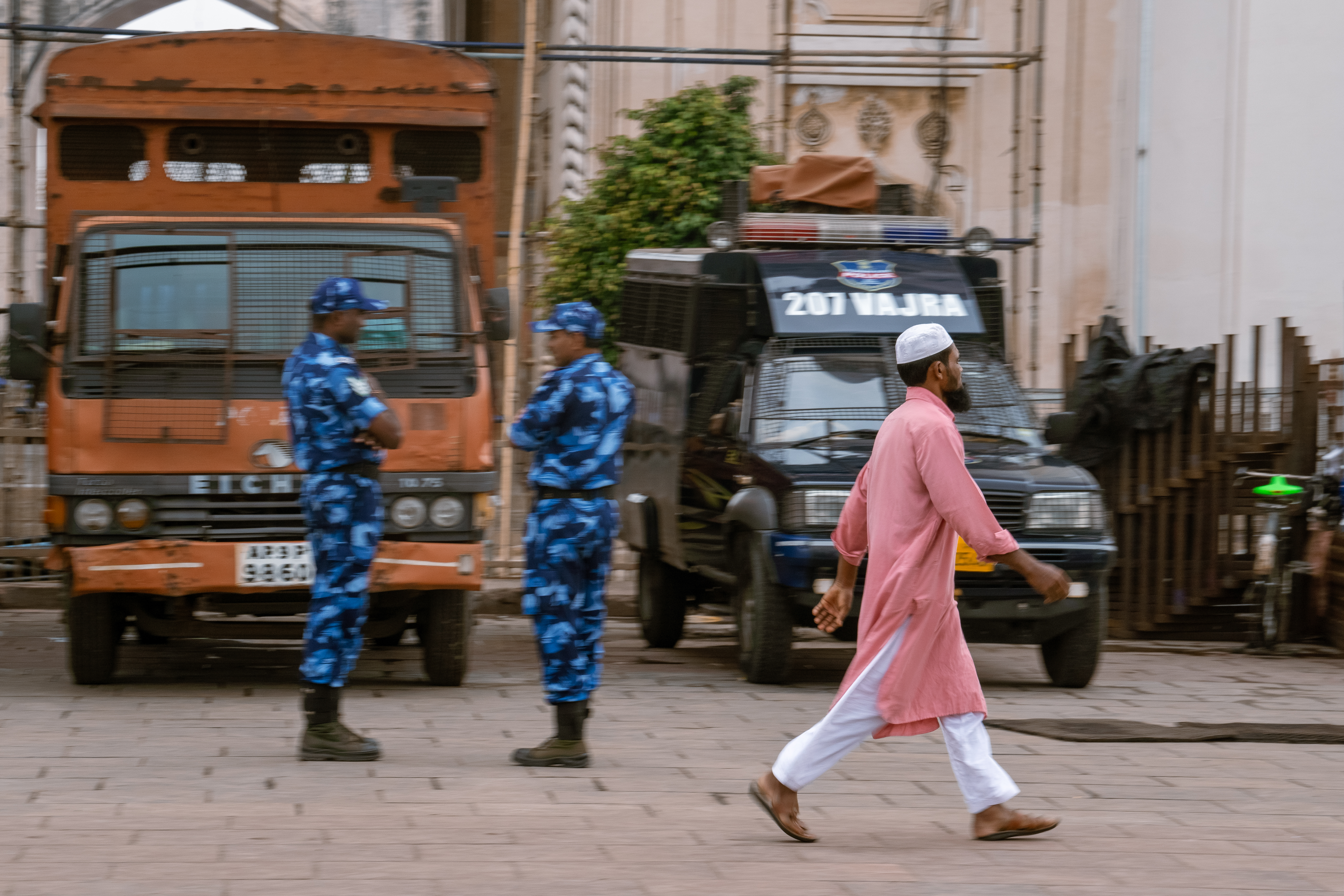
I contend that the responsibility of maintaining ‘peace’ falls into the hands of Indian Muslims, their position is not of subalternity, rather they are subalternat-ed through the constant deployment of peace narratives; where peace is not earned, it is rather, regulated through stringent police activity, unfair trials, and illegal demolitions of property; bestowing the Hindutva-‘fringe’, an administrative freehand to partake in acts of both physical or symbolic violence against the Muslim community. In an effort to illustrate this phenomenon, I will be taking the recent example of the Grand Milad-un-Nabi Procession, which had to take place on 5th September in Hyderabad, and, in lieu of the Ganesh idol immersion that falls on 6th September, was postponed by the State Government to 14th September.
Milad-un-Nabi is celebrated by a group of Sunni Muslims marking the birth date of Islam’s last Prophet – Muhammad (SAW). The transformation of Milad-un-Nabi from a private affair to a public spectacle, and the outpouring of believers onto the streets, especially from the ‘Barelvi’ maslak, is a “(re)invented tradition” brought into existence for the purpose of claiming political, material, and symbolic space in the national and urban space. Theological hermeneutics aside, the Milad-un-Nabi procession, as is the case with most mass-processions, operates on the symbolic intermittent occupation of public spaces, serving as a liminal redefinition of them and thereby revealing their contested nature. However, ‘tensions’ do seem to appear whenever the Hindus and Muslims have mass festivals on the same day, or around the time of the festival.
To understand why Indian Muslims are positioned as the sole spokespersons for peace, one must look deeper, though not too deeply, as such constructions are no longer hidden from the public realm. The Indian state operates on the presupposition of Indian Muslims being naturally prone to violence; for example, a study jointly conducted by Common Cause and Lokniti-CSDS shows that around 50 per cent of the police forces believe in Muslims being innately inclined towards committing acts of violence.
Despite being an egregiously prejudiced way of thinking, it holds sway over the administrative apparatuses, resulting in policies that meander around such constructions of Muslims. Where Muslims are always seen as aggressors, and the Hindus, despite being the majority community, are considered to be weak and effeminate, therefore any Hindu aggression is seen as an act of defence against the Muslims, who are labelled to be naturally aggressive. Furthermore, social anthropologist Julia Eckert, highlights precisely this while arguing towards the “growing double standard in Indian law or of a dual law that judged Muslim violence and protest as terrorism and Hindu violence as “natural reaction” or spontaneous “outburst”” Hence, the peace-building process is marred by presuppositions that place the burden of peace onto Muslims, who, in order to prove otherwise, must endure barrage after barrage of violence.
Having stated the preexisting presumptions that are in place and are always ready for activation, now we can focus on the case at hand.
For this year’s Ganesh procession, contra assumptions of Hindu effeminacy, the major mosques along the route of the procession had “been covered with white cloth to avoid any untoward incidents. This implies that the state recognises the possibility of such incidents—that is, it tacitly acknowledges the procession’s tendency toward violence, even if it never states this explicitly.. One is here reminded of the Home Minister’s proclamation in the Rajya Sabha that ‘no Hindu can ever be a terrorist’. Highlighting the ambivalence of the state apparatus: on the one hand, anticipating violence; on the other, claiming that Hindus cannot be violent.”
Another reason for invisibilizing the visible, to temporary-erase the permanent, points towards the dangerous tendency of ascribing agency to these building – making them aggressors that might lead to ‘spontaneous outburst’ among the Hindu participants; this is what one infers from what senior officials from the Uttar Pradesh police told the journalists covering the festival of Holi, stating such arrangements have been put in place “To avoid any law and order situation arising out of throwing of shoes and slippers, all the mosques and shrines have been covered properly,” Therefore, riddled within this obvious irony, is the ever-present myth of Muslim aggression – which ascribes an agency to the mosque. These mosques are perceived as unwanted obstructions, the sight of which might provoke Hindu revellers into violence. Yet what remains present, though elusive, is the limited recognition that Hindus themselves can be violent.
Therefore, following a meeting between Chief Minister A. Revanth Reddy, with AIMIM leaders Asaduddin Owaisi and Akbaruddin Owaisi, senior officials, and a member of the Central Milad Procession Committee, it was unanimously ‘decided’ to shift the Milad procession to the 14th of September, 2025. Such a move highlights the burden of peace and the question of who bears responsibility for maintaining it—for peace is, in and of itself, political.
Moreover, having been termed as aggressors, Indian Muslims bear the burden of peace. Such a burden is visible in everyday acts, including maintaining ‘peace’ when faced with the blaring of Hindutva-pop during prayer times; rescheduling Muslim processions when they coincide with Hindu festivities; avoiding the use of roads for congregational prayers; and being urged to conduct the Milad-un-Nabi events peacefully.
Such everyday acts, which aim to maintain peace, beget a more analytically challenging question about the burden of peace and who bears it. Both asking the question and formulating an answer are challenging, yet it is only after such challenges that one can hope for change.
To conclude, confronting the existing reality is not limited to critique; critique qua critique is not pursued for its own sake. Rather, critique is what leads to the conceptualisation of a future—a future where we share the burden, the burden of striving for the possibility of something better.
Saiyid Ashraf Husain Jafri is a student at Ibn Haldun University, Turkey.