When guardian becomes mirror: Contesting judicial role in democracy

Syed Shadab Asdaque and Mohammad Rehan
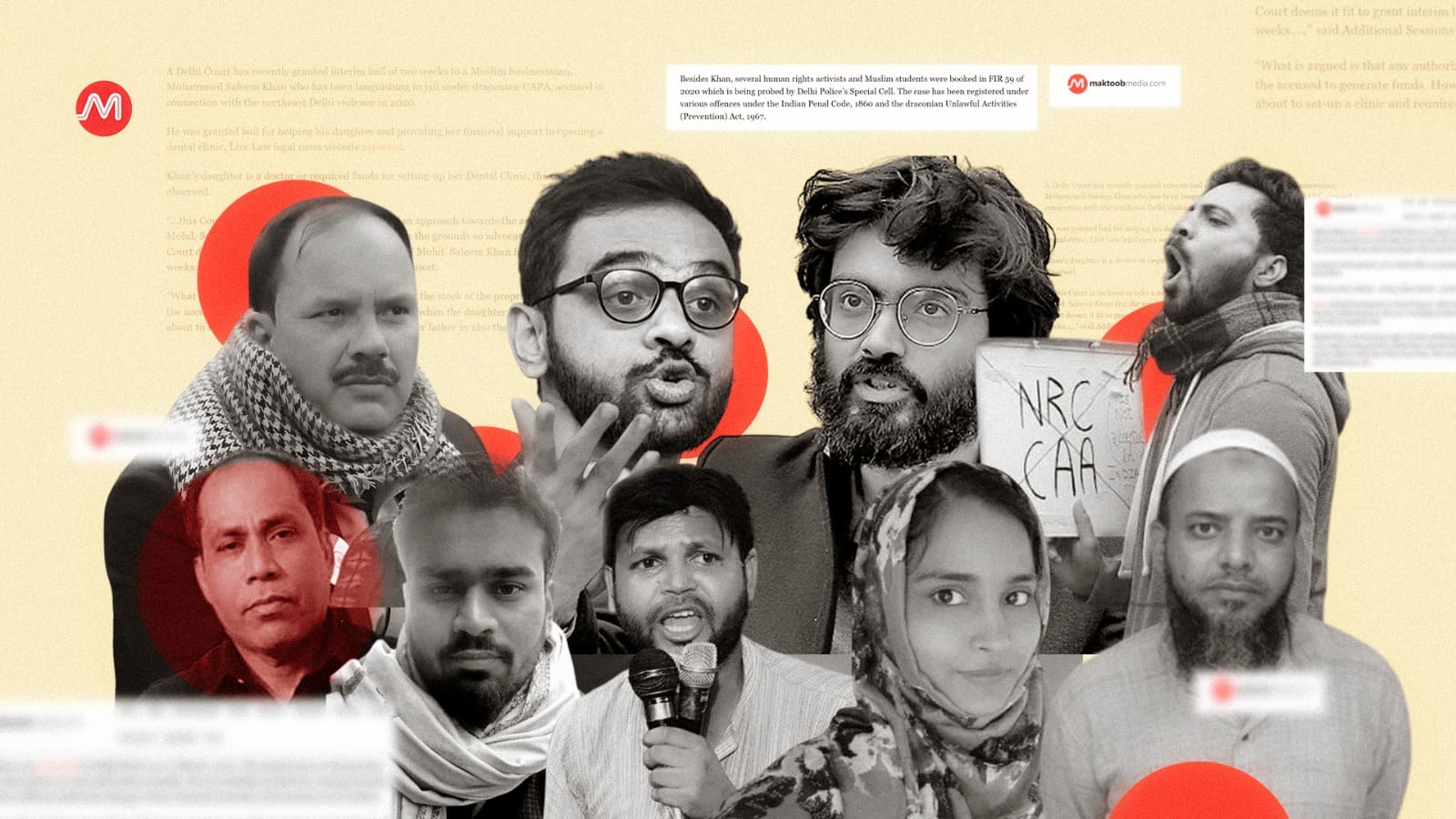
“The survival of our democracy … depend[s] upon the realisation that constitutional morality is no less essential than constitutional legality.” These words of Nani Palkhivala, spoken in the shadow of India’s constitutional crises, continue to resonate with unsettling clarity today. On September 2, 2025, the Delhi High Court denied bail to Umar Khalid, Sharjeel Imam, Gulfisha Fatima, and others accused under the Unlawful Activities (Prevention) Act (UAPA). They have now spent over five years in prison without their trial even beginning. The denial itself may not surprise, given the harsh bail conditions under UAPA, but the prolonged nature of their incarceration compels an uncomfortable question: when the process itself begins to resemble punishment, what does democracy truly mean?
The case has its roots in the tumultuous protests against the Citizenship Amendment Act and the communal violence that gripped Delhi in early 2020. The police alleged a “larger conspiracy,” piecing together WhatsApp groups, transcripts of speeches, and fundraising activities to construct their narrative. The accused were charged under UAPA, where Section 43D(5) makes bail nearly impossible once a court is convinced of a prima facie case. Yet more than five years on, the trial has scarcely moved. Individuals continue to languish in jail not because they have been convicted but because the law and its interpretation by courts make liberty nearly unattainable until the end of a trial whose horizon keeps shifting. Should the role of the courts in such circumstances not be to ask whether liberty, rather than prolonged confinement, ought to be the constitutional default?
The Delhi High Court’s recent order has generated significant debate, not least because it touches the core of constitutional freedoms and judicial responsibility. Legal scholar Gautam Bhatia has argued that the judgment represents an extreme form of what he terms the “eyes wide shut” approach: instead of subjecting the prosecution’s claims to rigorous scrutiny, the Court appears to have adopted them wholesale. According to him, the reasoning employed reflects a troubling willingness to stretch vague inferences — WhatsApp group membership, the use of words like inquilabi salam, or phone calls after the riots had already begun — into proof of a grand conspiracy. Such an approach, Bhatia suggests, replaces judicial vigilance with judicial abdication, raising uncomfortable questions about whether courts are insulating state narratives from challenge rather than testing them against evidence and law.
The Indian Express, in its editorial response, also expressed deep unease, though in a somewhat different register. It emphasized the judiciary’s failure to draw “vital distinctions” — particularly between constitutionally protected freedoms such as dissent and assembly, and direct incitement to violence. Instead of upholding the higher threshold of proof necessary under the Unlawful Activities (Prevention) Act, the Court appeared to accept the prosecution’s theory of a “shadowy conspiracy” as sufficient grounds to deny bail after more than five years of incarceration without trial. The editorial highlighted the troubling implications of this stance: if protest and association themselves can be recast as terrorism, then the boundaries between lawful dissent and criminal conspiracy become perilously blurred.
Taken together, these critiques raise a broader question: if courts defer so readily to the state’s claims in cases where liberty has already been curtailed for half a decade, do they not risk eroding the very presumption of innocence that anchors democratic constitutionalism? And if the judiciary itself begins to blur the line between dissent and incitement to violence, who remains to protect citizens from the state’s most coercive powers?
Further, these critiques raise a deeper anxiety: when courts appear to endorse the state’s version of events without rigorous scrutiny, do they begin to function less as guardians of liberty and more as extensions of state power? Indian constitutional law has traditionally not treated the judiciary as “the State” under Article 12. Yet, if judicial conduct seems to facilitate rather than restrain executive overreach, is it not worth asking whether some judicial decisions, particularly those affecting personnel liberty, might need to be conceptualised as ‘state action’ in substance, if not formally?
To understand this phenomenon fully, it is helpful to situate the judiciary in the Indian political arena. As Upendra Baxi observes, the Indian Court occupies a central and complex space in political affairs: it is drawn into both oppositional and establishment politics, acting not only as the final arbiter of legal disputes but also as the chief settler of political questions. The introduction of Public Interest Litigation and judicial pronouncements in recent cases — such as Ram Janmabhoomi, Triple Talaq, and the Hijab Ban — exemplify this ever-expanding political role and its profound impact on shaping political landscapes and aspirations.
At the same time, critics of the Indian judiciary view it as part of the “superstructure” in a bourgeois society, designed to protect the interests of the ruling class, often manifesting through dominant caste and social orders. This perspective aligns with Gramsci’s conception of law as an instrument for the state to maintain a specific societal order, shaping customs and attitudes while marginalising others. Seen through this lens, the prolonged incarceration of the individuals under UAPA raises the question of whether judicial deference in such cases simply upholds the law, or whether it may inadvertently reinforce existing social and political hierarchies.
This question is neither abstract nor novel. During the Emergency, the infamous decision in ADM Jabalpur v. Shivkant Shukla (1976) saw the Supreme Court endorse the suspension of fundamental rights, ruling that even the right to habeas corpus could be suspended, a failure it later admitted and disowned. As journalist Seema Chishti has noted, legal scholars such as Upendra Baxi regarded the judgment as a moment of judicial abdication, when the Court faltered in its role as guardian of liberty and appeared complicit with state repression. That episode remains a sobering reminder of how easily constitutional promises can erode when courts fail to uphold their duty.
At stake is not merely the fate of nine individuals but the meaning of Article 21 of the Constitution and the principle of the rule of law. The Supreme Court has repeatedly reminded us that bail is the rule and jail the exception. Justice D.Y. Chandrachud has described bail as the “solemn expression of the humaneness of the justice system.” Chief Justice Gavai, too, has recently lamented how this principle seems forgotten in recent years. Yet the logic of UAPA, coupled with judicial practice, seems to invert this constitutional norm: jail becomes the rule, bail the exception. If individuals can spend half a decade behind bars without conviction and without trial, is Article 21 not at risk of being reduced to an empty promise?
What does democracy look like when the very institutions that are meant to safeguard liberty appear instead to facilitate its denial? This question becomes sharper in light of how prolonged incarceration creates a chilling effect beyond the individuals concerned. It signals to all citizens—especially those who dissent—that their liberty may be contingent not on guilt proven at trial but on suspicion endorsed by judicial authority. Is this not the beginning of punishment by process rather than punishment by law?
Other democracies have grappled with similar dilemmas. The United States Supreme Court has struck down vague statutes for chilling free speech. South Africa’s Constitutional Court has vigorously defended the right to protest as integral to constitutional democracy. Even within India, some high courts have recognised that prolonged custody without trial and overcrowded prisons make continued detention unjustifiable. These examples remind us that courts do not inevitably side with the state; they can, and often do, act as bulwarks against executive excess. Perhaps the time has come to reflect on whether our jurisprudence might also evolve in that direction.
It is here that the role of the Supreme Court becomes crucial. History offers both warning and hope. The warning is that, as in ADM Jabalpur, the judiciary can falter gravely in moments of crisis. The hope is that the same institution can later acknowledge its mistake and correct the course. If constitutional morality is indeed, as Palkhivala insisted, no less essential than constitutional legality, then might the task of the Supreme Court today be to ensure that legality does not become a cloak for injustice? Could the Court, mindful of both precedent and principle, reaffirm bail as a safeguard of democracy rather than an elusive privilege?
At the end, what emerges from the perspectives of Bhatia and other scholars is that this case is not only about Umar Khalid and others. It is about whether democracy in India will remain substantive or risk becoming form without content. When courts adopt an “eyes wide shut” approach, they risk substituting rigorous scrutiny with judicial abdication, leaving state narratives largely untested. The judiciary has long described itself as the “sentinel on the qui vive” — the ever-watchful guardian of rights. But when the sentinel appears to mirror the state, who then safeguards democracy? Perhaps the apex court reclaim this role, not as an act of grace, but as a constitutional duty, reaffirming that the Constitution still breathes and that liberty, once promised, cannot be indefinitely deferred.
Syed Shadab Asdaque is an Assistant Professor of Law. His interests lie in Constitutional Law and Critical Jurisprudence. Mohammad Rehan is an Assistant Professor of Law at Maniar College of Law.